| Target Crop Type | — |
| Current Growth Phase | — |
| N-Nitrogen: Grow | — |
| P-Phosphorus: Bloom | — |
| K-Potassium: Boost | — |
| Cal-Mag / Micro Dose | — |
| Next Feeding Reminder | — |
| Plant Health Status | — |
Achieving maximum yield and pristine quality from cultivated crops demands precise nutrient management. A well-structured growth phase fertilizer schedule acts as the central nervous system of any high-performance agricultural project. By mapping out a strict plant feeding reminder calendar, cultivators eliminate guesswork and provide the exact elemental building blocks required at the exact moment of biological demand.
This comprehensive guide explores the deep mechanics of plant nutrition, the mathematics of nutrient mixing, and the critical environmental factors that dictate successful cultivation. 1000s of harvests are ruined annually simply because growers fail to align their feeding strategies with the internal biological clock of their crops. Moving away from static feeding to dynamic, phase-specific nutrition is the 1st step toward true agricultural mastery.
Table of Contents
The Biological Imperative of Timed Nutrition
Plants do not consume food in a static manner. Their dietary requirements shift dramatically as they transition from fragile seedlings to mature, fruit-bearing organisms. Supplying a flat nutrient profile across the entire lifecycle results in inevitable bottlenecks — either toxicities from unused minerals or severe deficiencies during peak developmental windows. Implementing a dynamic feeding schedule ensures that the root zone environment perfectly mirrors the above-ground biological intent.
▸ When a seed germinates, its biological objective is purely structural. It needs to build roots, stems, and initial leaves. When the light cycle shifts or the plant reaches genetic maturity, the objective changes entirely to reproduction and heavy fruit production. Each of these 2 distinct biological goals requires a completely different chemical fuel mix. By tracking these changes on a strict plant feeding reminder calendar, you ensure that the substrate is always pre-loaded with the correct minerals precisely 1 to 2 days before the crop actually begins to metabolize them. This proactive approach prevents the dreaded lag time where a plant starves while waiting for top-dressed amendments to break down.
Decoding the Elemental Building Blocks
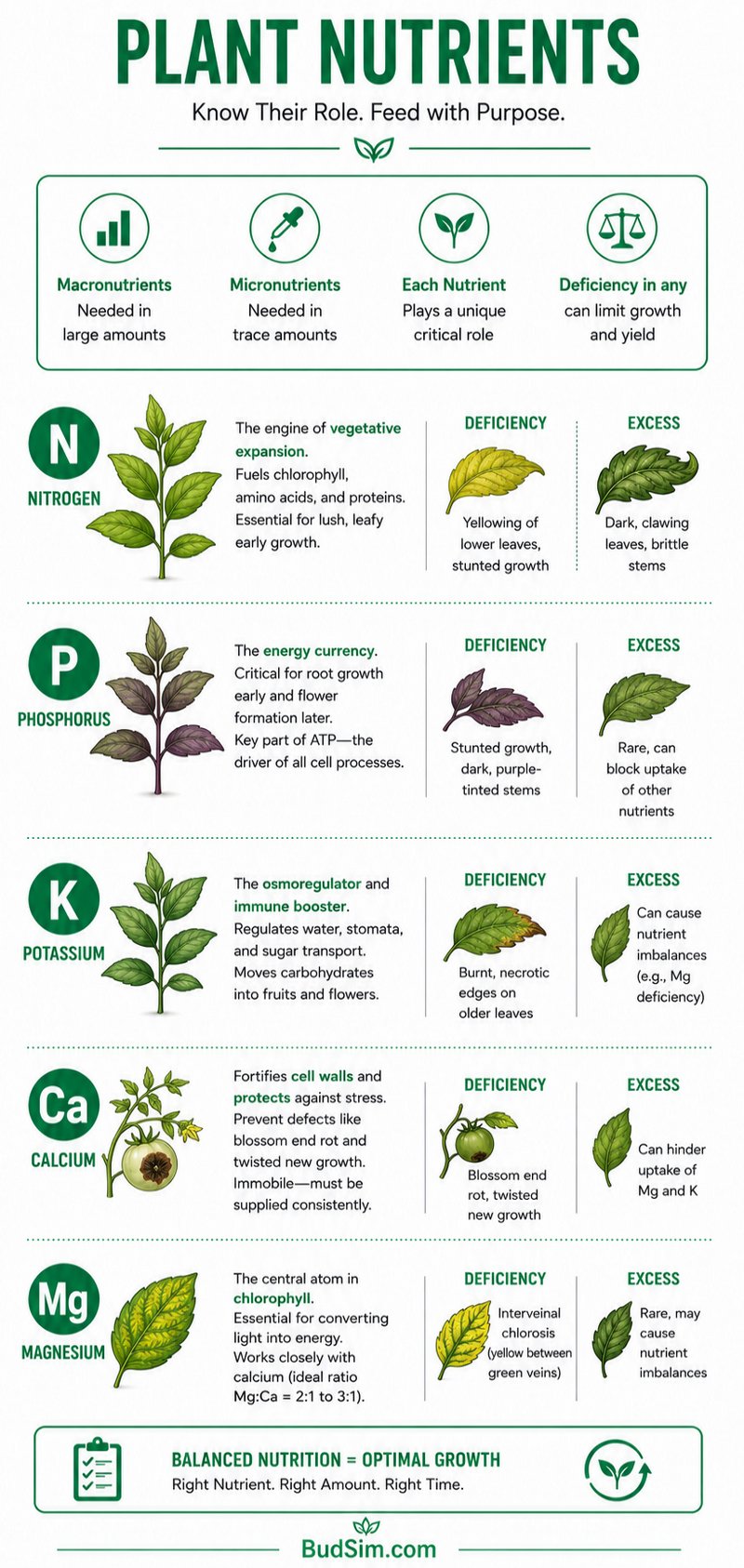
Understanding the primary elements is the absolute 1st step to mastering any feeding calendar. Nutrients are categorized by the volume at which the plant consumes them. Macronutrients are needed in massive quantities, while micronutrients are required only in trace amounts. However, a deficiency in a trace element can be just as catastrophic as a deficiency in a primary macronutrient due to the law of the minimum.
- Nitrogen — N. This is the engine of vegetative expansion. Nitrogen fuels the production of chlorophyll, amino acids, and vital proteins. During the early weeks of life, plants demand massive quantities of nitrogen to build the structural foundation required to support heavy harvests later. Without adequate nitrogen, growth halts entirely, and the lower foliage turns aggressively yellow as the plant cannibalizes its own mobile reserves to keep the apical tip alive. Excess nitrogen, conversely, leads to dark, clawing leaves and brittle stems.
- Phosphorus — P. The universal energy currency. Phosphorus is critical for root proliferation in the 1st weeks and the massive formation of flower sites later on. As daylight hours dwindle or the biological clock triggers the bloom phase, phosphorus demand skyrockets. It is a key component of ATP — the molecule that drives every metabolic process within the cellular structure. A lack of phosphorus results in stunted growth and dark, purple-tinted stems.
- Potassium — K. The ultimate osmoregulator and immune system booster. Potassium controls stomatal opening, water uptake, and the transportation of complex sugars across the cell walls. Heavy fruit production relies heavily on sustained potassium availability. It acts as the traffic controller, moving starches and carbohydrates from the leaves down into the expanding fruits or floral clusters. Potassium deficiency manifests as burnt, necrotic edges on older leaves.
- Calcium — Ca. This secondary macronutrient fortifies cell walls and protects the organism against extreme environmental stress. A lack of calcium leads directly to catastrophic failures like blossom end rot in tomatoes or stunted, twisted apical growth in heavy feeders. Calcium is highly immobile, meaning the plant cannot move it from old growth to new growth. Therefore, it must be supplied continuously through the nutrient solution.
- Magnesium — Mg. The literal central atom in the chlorophyll molecule. Without magnesium, plants simply cannot convert intense light into usable energy. This leads to aggressive interveinal chlorosis, where the veins remain green but the space between them turns pale yellow. Magnesium works closely in a delicate ratio with calcium, usually balanced at 2 to 1 or 3 to 1 in professional liquid formulas.
Chronological Breakdown of the Cultivation Cycle
To fully utilize a growth phase fertilizer schedule, the cultivator must divide the plant lifecycle into distinct, mathematically trackable epochs. Each epoch requires a specific shift in the reservoir chemistry.
Phase 1 — Seedling and Early Rooting
Duration: 1 to 3 weeks. During this fragile initial stage, the priority is establishing a robust subterranean root system. High fertilizer concentrations will instantly burn delicate root hairs. The optimal strategy involves micro-dosing base nutrients at 0.25 strength and relying heavily on root-stimulating additives like beneficial microbes, mycorrhizal fungi, and humic acids. The feeding reminder calendar should focus on maintaining high humidity rather than heavy drenching. Target conductivity should remain low, and the substrate must be allowed to dry out slightly to force the roots to search for moisture.
Phase 2 — Aggressive Vegetative Expansion
Duration: 2 to 8 weeks depending on the genetic lineage. Once roots hit the physical boundaries of their container, vertical and lateral growth explodes. The fertilizer schedule must pivot immediately to a nitrogen-heavy profile. Water consumption increases by 10 to 20 percent daily, requiring strict adherence to the calendar. The goal here is biomass accumulation. The stems must thicken to support future weight. Foliar spraying is highly effective during this phase, allowing nutrients to bypass the root zone and enter directly through the stomata on the underside of the leaves.
Phase 3 — The Pre-Bloom Transition
Duration: 1 to 2 weeks. This is the most critical physiological pivot point. The plant stretches rapidly, establishing the framework for fruit and flower production. The nutrient solution must shift to a balanced profile, tapering nitrogen while steadily increasing phosphorus and potassium. Many growers make the mistake of completely cutting nitrogen here, which leads to premature yellowing. The plant still needs nitrogen to fuel the massive stretch, but the ratio of phosphorus must overtake it to trigger aggressive bud site formation.
Phase 4 — Peak Floral and Fruit Production
Duration: 4 to 10 weeks. Nitrogen is dramatically reduced to trace levels. Phosphorus and potassium become the overwhelmingly dominant elements. Calcium supplements are absolutely crucial here to support the sheer physical weight of developing fruit and prevent cellular wall collapse under heavy transpiration. The plant will consume massive amounts of water. If the environment is hot, the base nutrient strength must actually be lowered to prevent toxic salt buildup, as the plant will drink more water than minerals to cool itself down.
Phase 5 — Ripening and Senescence
Duration: 1 to 2 weeks. Base nutrient application ceases entirely. The feeding calendar dictates pure water or specialized clearing solutions to force the plant to consume its internal mineral reserves. This senescence process dramatically improves the final flavor, aroma, and overall culinary quality of the harvest. The leaves will naturally fade to yellow, red, or purple. This is a sign of a perfect biological finish, indicating that no harsh residual salts are trapped inside the plant tissues.
The Mathematics of Precision Mixing
Precision agriculture relies on strict mathematical formulas rather than estimations. When mixing large reservoirs, understanding the calculation prevents catastrophic nutrient lockout. Cultivators measure the strength of their solution using Electrical Conductivity — EC — or Parts Per Million — PPM. EC is the universal scientific standard.
Formula 1 — Total Nutrient Volume Calculation
Vtotal = Vwater * Cdose
Where Vtotal is the total volume of fertilizer needed in milliliters. Vwater is the total reservoir volume in liters. Cdose is the target concentration in milliliters per liter. If you have a 50 liter reservoir and need 2.5 milliliters per liter, you add exactly 125 milliliters of product.
Formula 2 — Electrical Conductivity Balancing
ECfinal = ECsource + ECfertilizer
Where ECfinal is the target conductivity of the mixed solution. ECsource is the baseline conductivity of your tap or filtered water. ECfertilizer is the mineral content added by the liquid nutrients. If your tap water has an EC of 0.3, and adding 125 milliliters of fertilizer raises the EC by 1.5, your final reservoir EC will read 1.8 on a calibrated digital meter.
Formula 3 — Precision pH Adjustment
pHadj = pHcurrent – Vdown * 0.1
When adjusting pH down, strong phosphoric acid is typically used. In a standard 10 liter bucket, adding 1 milliliter of high-grade pH-down will lower the pH by approximately 0.5 to 1.0 points depending on the buffering capacity of the base water. Always mix nutrients fully before adjusting pH, as the fertilizers themselves are highly acidic and will naturally lower the pH of the tap water.
Strategic Reference Tables for Cultivators
The following tables represent optimized targets for various stages and specific crops. Use these metrics as the foundation for your plant feeding reminder calendar. Adjustments of 10 to 15 percent may be necessary based on specific environmental extremes.
Table 1 — Stage by Stage Nutrient Ratios and Target Strength
| Lifecycle Phase | N-P-K Ratio Target | Target EC Level |
|---|---|---|
| 1 — Early Seedling | 1 – 1 – 1 | 0.4 to 0.6 |
| 2 — Early Vegetative | 3 – 1 – 2 | 0.8 to 1.2 |
| 3 — Peak Vegetative | 4 – 2 – 3 | 1.3 to 1.8 |
| 4 — Pre-Bloom Transition | 2 – 2 – 3 | 1.6 to 2.0 |
| 5 — Early Bloom Set | 1 – 3 – 4 | 1.8 to 2.2 |
| 6 — Mid Bloom Bulking | 1 – 4 – 5 | 2.0 to 2.5 |
| 7 — Late Bloom Hardening | 0.5 – 3 – 4 | 1.5 to 1.8 |
| 8 — Late Ripening | 0 – 1 – 2 | 0.8 to 1.2 |
| 9 — Final Flush | 0 – 0 – 0 | 0.0 to 0.2 |
Table 2 — Comprehensive Crop Specific Nutritional Guidelines
| Crop Variety | Optimal pH Range | Maximum Bloom EC |
|---|---|---|
| Tomatoes | 6.0 to 6.8 | 2.5 to 3.5 |
| Peppers and Chilis | 5.8 to 6.5 | 2.2 to 2.8 |
| Eggplants (Aubergines) | 5.8 to 6.5 | 2.2 to 2.8 |
| Cucumbers | 5.8 to 6.5 | 2.0 to 2.6 |
| Zucchini and Summer Squash | 6.0 to 6.8 | 1.8 to 2.4 |
| Pumpkins and Winter Squash | 6.0 to 6.8 | 1.8 to 2.4 |
| Melons and Watermelons | 6.0 to 6.8 | 2.0 to 2.5 |
| Blueberries | 4.5 to 5.2 | 1.2 to 1.6 |
| Strawberries | 5.5 to 6.5 | 1.4 to 1.8 |
| Raspberries and Blackberries | 5.5 to 6.5 | 1.2 to 1.6 |
| Grapes (Vines) | 5.5 to 6.5 | 1.5 to 2.0 |
| Leafy Greens and Lettuce | 6.0 to 7.0 | 1.2 to 1.8 |
| Spinach | 6.0 to 7.0 | 1.4 to 1.8 |
| Kale and Swiss Chard | 6.0 to 7.0 | 1.4 to 2.0 |
| Broccoli, Cabbage and Brassicas | 6.0 to 7.2 | 2.2 to 2.8 |
| Basil | 5.5 to 6.5 | 1.0 to 1.6 |
| Mint | 6.0 to 7.0 | 1.2 to 1.6 |
| Rosemary, Thyme and Dry Herbs | 6.0 to 7.0 | 1.0 to 1.4 |
| Legumes, Peas and Beans | 6.0 to 7.5 | 1.5 to 2.0 |
| Root Crops (Carrots, Beets) | 6.0 to 6.8 | 1.5 to 2.0 |
| Potatoes | 5.0 to 6.0 | 1.8 to 2.5 |
| Radishes | 6.0 to 7.0 | 1.2 to 1.8 |
| Garlic and Onions | 6.0 to 7.0 | 1.4 to 2.2 |
| Asparagus | 6.5 to 7.5 | 1.6 to 2.2 |
| Citrus Trees (Lemon, Orange) | 5.5 to 6.5 | 2.0 to 2.5 |
| Heavy Feeders and Medicinals | 5.8 to 6.2 | 2.5 to 3.0 |
| Hops (Vine) | 6.0 to 6.5 | 2.0 to 2.6 |
| Roses | 6.0 to 6.5 | 1.5 to 2.2 |
| Ornamental Flowers (General) | 6.0 to 7.0 | 1.6 to 2.2 |
| Orchids | 5.5 to 6.0 | 0.5 to 0.8 |
| Succulents and Cacti | 6.0 to 7.0 | 0.8 to 1.2 |
| Ferns | 5.5 to 6.5 | 0.6 to 1.0 |
Table 3 — Advanced Diagnostic Guide for Visual Imbalances
| Elemental Imbalance | Primary Visual Symptoms | Correction Strategy |
|---|---|---|
| Nitrogen Deficiency | Lower older leaves turn uniform yellow and drop off early. Plant growth stalls. | Increase base grow nutrient by 20 percent for 1 week. |
| Nitrogen Toxicity | Leaves turn extremely dark green, shiny, and bend downwards wildly (the claw). | Flush substrate with 0.5 strength solution to clear excess salts. |
| Phosphorus Deficiency | Slow growth with distinct purple or dark red stems and petioles. Leaves may turn dark bluish-green. | Check pH to ensure it is above 5.8, then add a liquid bloom booster. |
| Phosphorus Toxicity | Rarely shows directly, but aggressively locks out Zinc and Iron, causing new growth yellowing. | Flush substrate and reduce bloom booster additives by half. |
| Potassium Deficiency | Older leaves look burnt or scorched exactly along the outer margins. Stems become weak. | Add potassium silicate or a heavy fruit-stage kelp additive. |
| Potassium Toxicity | Locks out Calcium, Magnesium, and Zinc. Lower leaves show severe spotting and interveinal chlorosis. | Perform a heavy pure-water flush, then reintroduce balanced base nutrients. |
| Calcium Deficiency | New apical growth is twisted, distorted, and covered in brown necrotic spots. Blossom end rot on fruits. | Apply foliar spray of calcium nitrate at 1 milliliter per liter immediately. |
| Magnesium Deficiency | Veins remain bright green but the tissue between them turns pale yellow, starting on mid-tier leaves. | Add Epsom salts or a dedicated liquid magnesium supplement to the reservoir. |
| Sulfur Deficiency | Entire plant turns pale yellow, but unlike Nitrogen, it starts on the NEW growth first. | Check pH. If correct, add magnesium sulfate (Epsom salts) which contains sulfur. |
| Iron Lockout / Deficiency | Entire new shoots emerge pure bright yellow or almost white, with no necrotic spotting initially. | Lower substrate pH immediately. Iron locks out severely in environments above 6.5 pH. |
| Zinc Deficiency | Severe interveinal chlorosis on new leaves. Leaves are extremely stunted and bunched together (rosetting). | Adjust pH to 6.0 or below and apply a chelated zinc foliar spray. |
| Manganese Deficiency | Interveinal chlorosis accompanied by dark brown necrotic spots on younger leaves. Often mistaken for calcium issues. | Usually a high pH lockout. Lower pH to 5.8 to 6.0 and flush the medium. |
| Copper Deficiency | Leaves appear very dark green but are heavily twisted, wilted, with dying tips. | Apply a trace mineral complex or a highly diluted foliar copper supplement. |
| Boron Deficiency | Abnormal, thick, brittle apical growth. Stems may become hollow. Roots grow short and stubby. | Extremely sensitive. Add highly diluted borax or boric acid, but strictly in micro-doses to avoid toxicity. |
| Molybdenum Deficiency | Older and middle leaves become mottled and pale, with the outer edges curling sharply upward. | Molybdenum locks out at low pH. Raise reservoir pH to 6.0 or slightly higher to restore availability. |
Substrate Dynamics and Feeding Frequencies
A schedule is not simply about what chemical to feed, but exactly when and how often to apply it. The physical frequency is dictated entirely by the chosen substrate. Coco coir, a popular hydroponic medium, contains 0 intrinsic nutrition. It acts purely as a physical anchor. Therefore, coco requires high-frequency fertigation. Plants grown in pure coco should ideally be fed 2 to 6 times per day during peak bloom. The calendar must remind the grower to never let coco dry out completely, as this spikes the remaining salt concentration to lethal levels.
◈ Soil, on the other hand, acts as a biological buffer. High-quality living soils contain massive reserves of organic matter. Soil cultivators might follow a schedule that requires liquid feeding only 1 time per week, utilizing pure, pH-balanced water for the remaining 2 or 3 irrigations. Deep Water Culture systems require constant, uninterrupted nutrient contact, meaning the main reservoir must be topped off daily with fresh water and swapped completely 1 time every 7 to 10 days to prevent anaerobic bacterial blooms.
Environmental Synergies and Uptake Rates
The growth phase fertilizer schedule does not exist in a vacuum. It must logically scale with the environmental intensity of the cultivation space. A crop positioned under 1000 watts of intense LED lighting running at 30 degrees Celsius with 1200 parts per million of supplemented CO2 will metabolize up to 3 times the nutrient volume of a crop grown under a weak 300 watt fixture at 24 degrees Celsius in ambient air.
Temperature drives transpiration. If the room temperature rises by just 4 or 5 degrees, the plant’s natural reaction is to drink more water to cool its foliage via evaporation. If the nutrient solution in the reservoir is running at a maximum EC of 3.0 during a heatwave, the plant will absorb massive amounts of water and drag lethal amounts of salts into its tissue alongside it, resulting in catastrophic tip burn within 24 hours. The master rule for the calendar is: as temperature rises, nutrient concentration must drop by 15 to 20 percent. Conversely, in cold, humid environments, transpiration slows down, allowing the grower to safely push higher EC levels.
Water Quality and Base Measurements
The chemical foundation of any growth phase fertilizer schedule is the starting water. Tap water contains varying levels of calcium carbonate, chlorine, chloramines, and heavy metals. An initial water test is mandatory. If the starting tap water has an EC above 0.4, it is highly recommended to invest in a Reverse Osmosis filtration system. Reverse Osmosis strips the water down to an EC of exactly 0.0. However, using completely pure water creates a dangerous vacuum. Pure water will actually aggressively strip minerals directly out of the plant roots through reverse osmosis. To prevent this, RO water must always be immediately buffered with a Cal-Mag supplement up to a baseline EC of 0.3 or 0.4 before any primary fertilizers are added.
The Crucial Role of Root Zone pH Management
Nutrient availability is dictated almost entirely by the pH of the liquid surrounding the roots. Even if the fertilizer schedule is flawlessly calculated and mixed to the exact milliliter, an incorrect pH will physically lock out essential minerals, starving the plant while the substrate remains full of food. For hydroponic and soilless systems, the absolute optimal range is tightly bracketed between 5.5 and 6.2. For heavy peat or soil systems, the buffer expands slightly from 6.0 through 6.8.
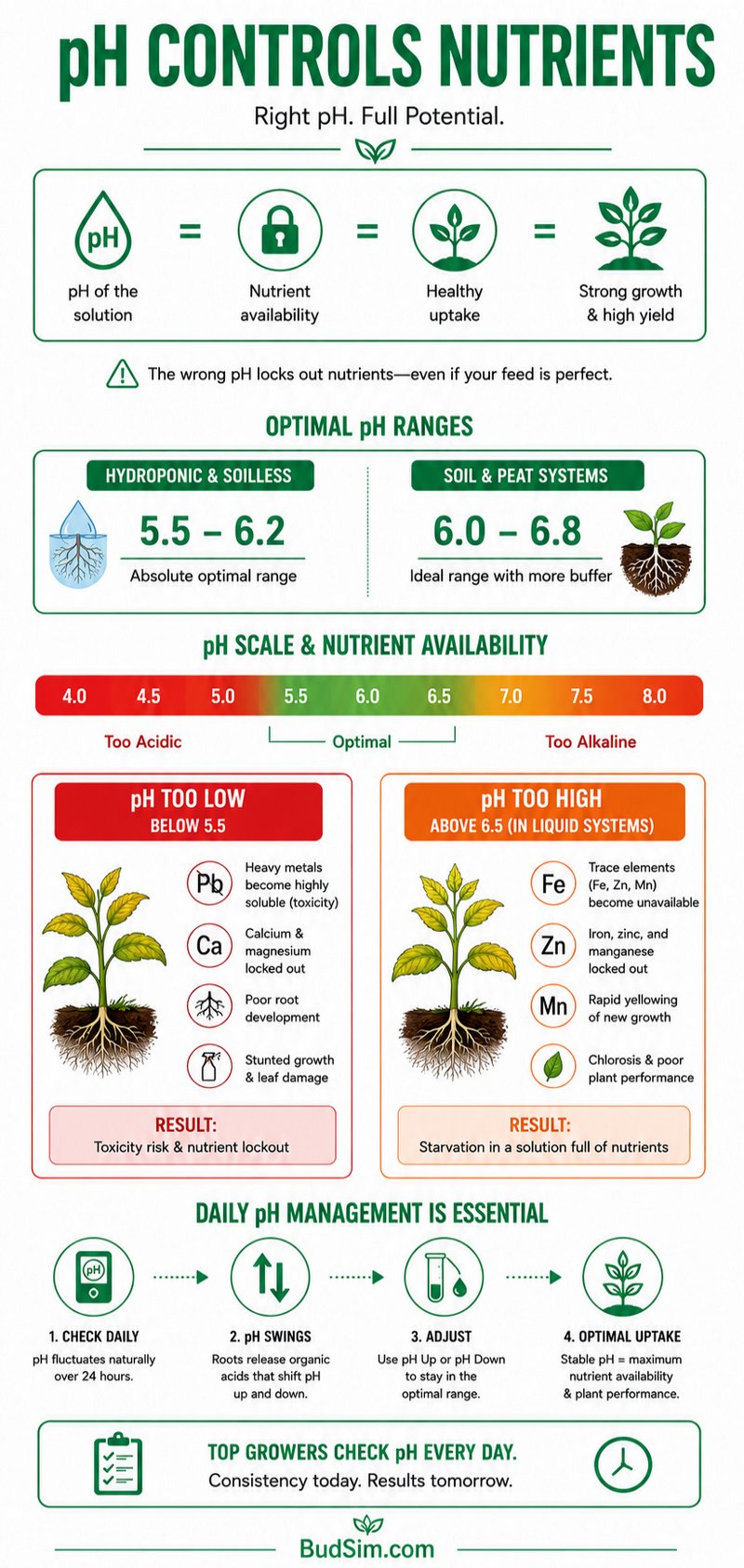
When pH drops violently below 5.5, heavy metals become highly soluble and can cause toxicities, while calcium and magnesium become locked out entirely. When pH rises above 6.5 in a liquid system, trace elements like iron, zinc, and manganese become chemically unavailable. This causes the rapid yellowing of all new apical growth. A top-tier plant feeding reminder calendar will include mandatory daily pH checks, as organic acids released by the roots will naturally swing the reservoir pH up and down over a 24 hour cycle.
Building the Ultimate Digital Reminder System
Relying purely on human memory for complex biological schedules invariably leads to critical errors. A digital or strictly written calendar should track the exact day of the vegetative or bloom cycle. Set up cascading alerts to maintain systemic stability. Alert 1 should trigger a complete reservoir change every 7 days to prevent ionic imbalances. Alert 2 should mandate a pH pen calibration with standardized 4.0 and 7.0 buffer fluids every 14 to 20 days. Alert 3 should remind the grower that foliar spray windows exist strictly during the 1st 3 weeks of the vegetative phase; spraying flowers later in the cycle invites catastrophic mold and bud rot.
◈ By integrating these physical measurements, mathematical calculations, and strict chronological tracking, a grower transforms from a reactive gardener into a proactive agricultural engineer. The result is consistently explosive growth, total immunity to common deficiencies, and harvests that consistently reach their maximum genetic potential.
Recommended Literature for Advanced Cultivators
- Hydroponic Food Production by Howard M. Resh
- Teaming with Microbes by Jeff Lowenfels
- Plant Nutrition and Soil Fertility Manual by J. Benton Jones Jr.
- Commercial Greenhouse Cucumber Production by Jeremy Badgery-Parker
- The Tomato Crop by J. Atherton

Harrison Caldwell— Smart Yard & Precision Agro Developer
Agricultural engineer and developer specializing in interactive landscape modeling and precision calculation algorithms.


