| Target Crop Selection | — |
| Root System Biology Type | — |
| Current Root Mass Density | — |
| Optimal Potting-Up Window | — |
| Critical Root-Bound Deadline | — |
| Substrate Needed (100 pl) | — |
| Hardening Off Recomm. Start | — |
| Overall Seedling Status | — |
Precision agriculture and modern nursery management rely heavily on predictable data. Guessing the right time to move a young plant from a propagation tray into a larger container leads to stunted growth, nutrient lockouts, or catastrophic transplant shock. The key to uninterrupted vegetative development lies in understanding the volumetric relationship between root mass and available substrate. By utilizing predictive modeling, growers eliminate guesswork and optimize their transplant schedules based on environmental inputs and species-specific biological constants.
Every seedling operates on a biological clock driven by temperature, moisture, and genetic vigor. Roots expand in 3 dimensions, actively seeking oxygen and soluble nutrients. When this expansion reaches the physical limits of a propagation cell, the plant enters a state of stress. The spatial geometry of the root zone dictates the entire physiological health of the upper canopy. Accurate tracking of this subsurface environment is what separates amateur gardeners from professional horticulturalists.
Table of Contents
The Biophysics of Root Expansion and Container Volume
A plant root system does not grow linearly; it branches and colonizes available space exponentially until physical barriers force a change in trajectory. In standard nursery trays, this barrier is the plastic wall of the cell. When primary roots strike this barrier, they deflect downwards and begin circling the bottom of the container. This phenomenon drastically reduces the efficiency of nutrient uptake and compromises the structural integrity of the mature plant.
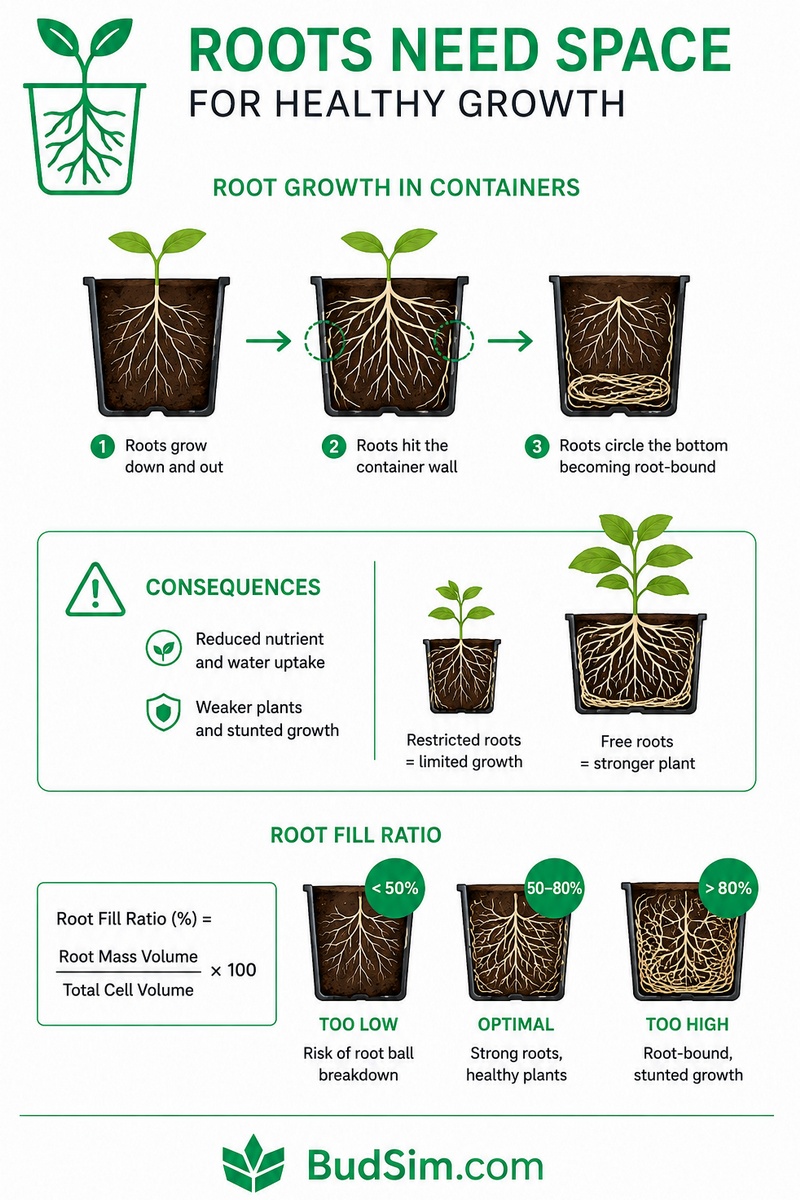
To quantify this process, agricultural engineers use a metric known as the root fill ratio. This ratio expresses the current volume of the root mass as a percentage of the total available cell volume. Maintaining this ratio within optimal parameters is the primary objective of early-stage plant management. If the ratio is too low, the substrate will lack structural integrity, causing the root ball to shatter during transplanting. If the ratio is too high, the plant becomes root-bound, leading to permanent stunting.
Calculating the Root Fill Ratio
The mathematical model for predicting root density relies on time, temperature, and species genetics. The basic expression for determining the fill percentage is as follows:
Rf = Mg / Vc * 100
Where Rf represents the final root fill ratio in percent. Mg stands for the total root mass generated since sprouting, and Vc is the total volume of the starting cell. The crucial variable here is Mg, which must be derived from dynamic environmental data rather than static calendars.
To calculate the generated root mass Mg, the following formula is applied:
Mg = D * Sr * Kt
In this equation, D is the exact number of days since the seed sprouted. Sr is the genetic root speed index unique to each specific crop. Kt represents the temperature multiplier, which dynamically adjusts the growth rate based on the ambient heat in the root zone.
By merging these formulas, growers can mathematically pinpoint the exact day a plant will transition from a fragile seedling into an optimal transplant candidate, and exactly when it will hit the critical root-bound stage.
Crop Specific Genetics and Root System Architecture
Not all plants behave identically below the soil surface. The genetic blueprint of a crop dictates both the velocity of its root expansion and its sensitivity to mechanical disturbance. Broadly, nursery crops are categorized by their root system architecture into 2 primary groups — fibrous systems and taproot systems.
- Crops featuring fibrous systems, such as tomatoes and peppers, develop a dense, multi-directional web of secondary roots. These plants are highly adaptable, recover rapidly from minor root damage, and generally tolerate a wider window of transplanting time. They actively benefit from being potted up deeper than their original soil line, as their stems can generate adventitious roots.
- Conversely, taproot species like cucumbers, melons, and pumpkins prioritize the rapid downward thrust of a single, dominant primary root. If this primary root strikes the bottom of a shallow cell and begins to circle, the plant interprets this as a permanent environmental limitation. Taproot crops suffer severe, often irreversible stunting if allowed to become root-bound. Their optimal transplant window is incredibly narrow, demanding precise predictive tracking.
| Crop Species | Root Speed Index | Root System Architecture |
|---|---|---|
| Tomatoes | 3.5 | Fibrous — Adaptable |
| Peppers | 2.2 | Fibrous — Adaptable |
| Cucumbers | 5.0 | Taproot — Sensitive |
| Lettuce | 4.0 | Fibrous — Adaptable |
| Eggplants | 2.0 | Fibrous — Adaptable |
| Zucchini | 6.5 | Taproot — Sensitive |
| Pumpkin | 7.0 | Taproot — Sensitive |
| Squash | 6.0 | Taproot — Sensitive |
| Melons | 5.5 | Taproot — Sensitive |
| Spinach | 3.0 | Taproot — Sensitive |
| Kale | 3.2 | Fibrous — Adaptable |
| Cabbage | 3.5 | Fibrous — Adaptable |
| Broccoli | 3.8 | Fibrous — Adaptable |
| Basil | 2.5 | Fibrous — Adaptable |
| Mint | 4.5 | Fibrous — Adaptable |
| Strawberries | 1.5 | Fibrous — Adaptable |
| Carrots | 6.2 | Taproot — Sensitive |
| Onions | 2.8 | Fibrous — Adaptable |
| Garlic | 2.7 | Fibrous — Adaptable |
| Radish | 5.8 | Taproot — Sensitive |
| Beets | 5.1 | Taproot — Sensitive |
| Potatoes | 4.4 | Fibrous — Adaptable |
| Sweet Potatoes | 4.8 | Fibrous — Adaptable |
| Corn | 6.8 | Fibrous — Adaptable |
| Wheat | 7.2 | Fibrous — Adaptable |
| Barley | 6.9 | Fibrous — Adaptable |
| Oats | 6.4 | Fibrous — Adaptable |
| Rice | 5.9 | Fibrous — Adaptable |
| Soybeans | 4.9 | Taproot — Sensitive |
| Peas | 4.6 | Taproot — Sensitive |
| Beans | 4.7 | Taproot — Sensitive |
| Sunflower | 6.7 | Taproot — Sensitive |
| Canola | 5.6 | Taproot — Sensitive |
| Alfalfa | 7.5 | Taproot — Sensitive |
| Clover | 6.1 | Fibrous — Adaptable |
| Parsley | 2.9 | Fibrous — Adaptable |
| Dill | 2.6 | Fibrous — Adaptable |
| Cilantro | 2.4 | Fibrous — Adaptable |
| Oregano | 2.1 | Fibrous — Adaptable |
| Thyme | 1.9 | Fibrous — Adaptable |
| Rosemary | 2.3 | Fibrous — Adaptable |
| Swiss Chard | 3.6 | Taproot — Sensitive |
| Arugula | 3.1 | Fibrous — Adaptable |
| Celery | 2.0 | Fibrous — Adaptable |
| Leeks | 2.7 | Fibrous — Adaptable |
| Asparagus | 4.2 | Taproot — Sensitive |
| Okra | 5.4 | Taproot — Sensitive |
| Cauliflower | 3.4 | Fibrous — Adaptable |
| Brussels Sprouts | 3.3 | Fibrous — Adaptable |
| Turnips | 5.2 | Taproot — Sensitive |
| Parsnips | 6.3 | Taproot — Sensitive |
| Rutabaga | 5.7 | Taproot — Sensitive |
| Endive | 3.0 | Fibrous — Adaptable |
| Bok Choy | 3.7 | Fibrous — Adaptable |
| Collard Greens | 3.9 | Fibrous — Adaptable |
| Mustard Greens | 3.2 | Fibrous — Adaptable |
| Watercress | 1.8 | Fibrous — Adaptable |
| Corn Salad | 2.2 | Fibrous — Adaptable |
| Fennel | 4.1 | Taproot — Sensitive |
| Artichoke | 4.3 | Taproot — Sensitive |
| Chives | 1.7 | Fibrous — Adaptable |
| Scallions | 2.3 | Fibrous — Adaptable |
| Napa Cabbage | 3.6 | Fibrous — Adaptable |
| Pak Choi | 3.5 | Fibrous — Adaptable |
| Romaine Lettuce | 4.1 | Fibrous — Adaptable |
| Butterhead Lettuce | 3.9 | Fibrous — Adaptable |
| Iceberg Lettuce | 4.2 | Fibrous — Adaptable |
| Green Beans | 4.8 | Taproot — Sensitive |
| Black Beans | 4.9 | Taproot — Sensitive |
| Lima Beans | 5.0 | Taproot — Sensitive |
| Peanuts | 5.3 | Taproot — Sensitive |
| Millet | 6.6 | Fibrous — Adaptable |
| Sorghum | 7.1 | Fibrous — Adaptable |
| Rye | 7.0 | Fibrous — Adaptable |
| Triticale | 6.8 | Fibrous — Adaptable |
| Quinoa | 4.5 | Taproot — Sensitive |
| Buckwheat | 4.6 | Taproot — Sensitive |
| Sesame | 5.2 | Taproot — Sensitive |
| Flax | 5.4 | Taproot — Sensitive |
| Mustard | 3.4 | Fibrous — Adaptable |
| Sun Hemp | 6.0 | Taproot — Sensitive |
| Teff | 6.2 | Fibrous — Adaptable |
| Amaranth | 4.8 | Taproot — Sensitive |
| Chickpeas | 5.1 | Taproot — Sensitive |
| Lentils | 4.7 | Taproot — Sensitive |
| Fava Beans | 4.9 | Taproot — Sensitive |
| Edamame | 4.8 | Taproot — Sensitive |
| Cranberries | 2.4 | Fibrous — Adaptable |
| Blueberries | 2.1 | Fibrous — Adaptable |
| Raspberries | 2.7 | Fibrous — Adaptable |
| Blackberries | 2.8 | Fibrous — Adaptable |
| Grapes | 3.2 | Woody — Deep |
| Apples | 3.0 | Woody — Deep |
| Pears | 2.9 | Woody — Deep |
| Peaches | 3.1 | Woody — Deep |
| Cherries | 2.8 | Woody — Deep |
| Plums | 3.0 | Woody — Deep |
| Strawberry Runners | 1.6 | Fibrous — Adaptable |
| Rhubarb | 3.4 | Fibrous — Adaptable |
| Horseradish | 5.9 | Taproot — Sensitive |
| Jerusalem Artichoke | 6.1 | Tuberous — Aggressive |
| Ginger | 4.3 | Rhizomatic — Spreading |
| Turmeric | 4.2 | Rhizomatic — Spreading |
| Lotus | 5.6 | Rhizomatic — Aquatic |
| Sugar Beet | 5.0 | Taproot — Sensitive |
The Critical Role of Root Zone Temperature
Above-ground air temperature is often mistakenly used as the primary metric for plant growth. However, the temperature of the substrate — the root zone — is the actual driving force behind cellular division in the root mass. Soil physics dictate that wet substrate remains significantly cooler than ambient air due to evaporative cooling. A room might feel warm at 25 degrees Celsius, while the wet soil in a propagation tray sits at a sluggish 18 degrees.
▸ Biological activity in the root zone follows a parabolic curve. At 15 degrees Celsius, root expansion is severely restricted, operating at roughly 20 % of its maximum potential. As the temperature climbs toward 22 degrees Celsius, metabolic efficiency reaches its zenith, resulting in a multiplier of 1.0. If the temperature exceeds 30 degrees Celsius, heat stress induces a metabolic shutdown, dropping the growth multiplier drastically as the plant shifts energy from growth to basic survival and transpiration.
Tracking the Kt variable is absolutely essential for accurate predictive modeling. A cucumber seedling grown at an optimal 22 degrees will fill a 50 milliliter cell in just 10 days. That exact same seed, grown at 17 degrees, will require over 16 days to reach the identical physical state. Ignoring temperature variables renders any calendar-based transplant schedule entirely useless.
| Root Temperature °F / °C | Growth Multiplier | Metabolic State |
|---|---|---|
| 50 / 10 | 0.05 | Extreme Dormancy |
| 51.8 / 11 | 0.08 | Very Slow Activity |
| 53.6 / 12 | 0.12 | Severe Dormancy |
| 55.4 / 13 | 0.15 | Minimal Uptake |
| 57.2 / 14 | 0.18 | Very Weak Growth |
| 59 / 15 | 0.20 | Severe Dormancy |
| 60.8 / 16 | 0.28 | Sluggish Growth |
| 62.6 / 17 | 0.36 | Sluggish Growth |
| 64.4 / 18 | 0.45 | Reduced Vigor |
| 66.2 / 19 | 0.52 | Reduced Vigor |
| 68 / 20 | 0.60 | Sub-Optimal |
| 69.8 / 21 | 0.68 | Approaching Normal |
| 71.6 / 22 | 0.75 | Good Vigor |
| 73.4 / 23 | 0.82 | Good Vigor |
| 75.2 / 24 | 0.90 | Excellent Vigor |
| 77 / 25 | 0.95 | Near Optimum |
| 78.8 / 26 | 1.00 | Maximum Efficiency |
| 80.6 / 27 | 0.98 | Peak Activity |
| 82.4 / 28 | 0.94 | High Efficiency |
| 84.2 / 29 | 0.88 | Warm Stress Threshold |
| 86 / 30 | 0.80 | Mild Heat Stress |
| 87.8 / 31 | 0.74 | Moderate Heat Stress |
| 89.6 / 32 | 0.68 | Elevated Respiration |
| 91.4 / 33 | 0.62 | Heat Load Increasing |
| 93.2 / 34 | 0.56 | High Heat Stress |
| 95 / 35 | 0.50 | Metabolic Decline |
| 96.8 / 36 | 0.42 | Serious Heat Stress |
| 98.6 / 37 | 0.35 | Root Function Reduced |
| 100.4 / 38 | 0.28 | Severe Stress |
| 102.2 / 39 | 0.20 | Critical Stress |
| 104 / 40 | 0.12 | Near Failure |
Substrate Volume and Logistics Planning
Beyond the biological timing of transplanting, managing substrate logistics is a major operational challenge. Whether running a small indoor tent or a commercial greenhouse, knowing exactly how much soil, coco coir, or peat mix to prepare prevents massive workflow interruptions. Substrate is heavy, expensive, and requires preparation — such as buffering, hydrating, or amending with perlite and fertilizers. The total volume of substrate required for a potting-up session scales linearly with the target container size and the total plant count.
The total substrate formula is:
Vtotal = N * Vt
Where Vtotal is the total required substrate volume, N is the exact number of plants being transplanted, and Vt is the internal volume of the single target pot. For instance, moving 100 tomato seedlings into 1.5 liter intermediate pots demands exactly 150 liters of prepared substrate. In imperial measurements, moving 50 pepper plants into 0.5 gallon pots requires 25 gallons of mix.
◈ Precision in these calculations prevents the common error of running out of soil halfway through a delicate transplanting operation, leaving bare-root seedlings exposed to dry air while emergency soil is mixed.
The 3 Phases of Nursery Development
The lifecycle of a seedling in a container is strictly divided into 3 distinct volumetric phases. Recognizing these phases is the core purpose of maintaining a rigorous transplant timeline.
Phase 1 — The Fragile State
This phase encompasses the period from initial germination until the root mass occupies roughly 30 percent of the cell volume. During this time, the roots are delicate, highly susceptible to mechanical tearing, and lack the structural density to bind the loose substrate together. Attempting to extract a plant during this phase will cause the soil to collapse, shearing off microscopic root hairs. These root hairs are the primary vectors for water absorption. Destroying them results in immediate wilt and severely delays overall development. Plants must remain strictly undisturbed during this fragile window.
Phase 2 — The Optimal Pot-Up Window
The optimal window opens when the root mass fills between 60 and 85 percent of the available volume. At this precise stage, the roots have thoroughly colonized the media, creating a cohesive, structured plug that slides easily out of the plastic cell. The root tips are healthy, white, and actively searching for new boundaries, but they have not yet begun to circle or choke themselves. Transplanting during this golden window guarantees zero transplant shock. The plant transitions into the new, larger volume of substrate seamlessly, immediately resuming exponential growth without missing a single day of metabolic productivity.
Phase 3 — The Critical Root-Bound State
When the fill ratio exceeds 95 percent, the plant enters a critical danger zone. The roots, having nowhere else to go, form a dense, impenetrable mat against the plastic walls. The ratio of solid root matter to porous substrate becomes violently skewed, virtually eliminating the soil’s capacity to hold water or oxygen. The plant requires constant watering but remains perpetually thirsty. In taproot species, this triggers hormonal panic, permanently stunting the plant’s final yield potential. Even adaptable fibrous plants will suffer severe yellowing of lower leaves as they cannibalize mobile nutrients to sustain new growth. If a plant reaches this stage, the root ball must be aggressively scored or teased apart before transplanting to force the roots to redirect outward, an inherently traumatic process.
| Growth Phase | Fill Ratio % | Required Grower Action |
|---|---|---|
| Initial Sprout | 0 to 10 | Maintain strict humidity and warmth. |
| Fragile Development | 10 to 30 | Do not disturb. Monitor soil moisture carefully. |
| Early Colonization | 30 to 50 | Begin mild nutrient application. |
| Approaching Optimal | 50 to 60 | Prepare target pots and mix bulk substrate. |
| Perfect Transplant Window | 60 to 85 | Pot-up immediately. Zero shock expected. |
| Late Window Warning | 85 to 95 | Transplant urgently. Roots beginning to circle. |
| Critical Root-Bound | 95 to 100 | Loosen root ball forcefully before emergency transplant. |
Real World Application and Example Calculation
To demonstrate the absolute necessity of these calculations, consider a standard scenario. A grower sprouts a tray of cucumbers — a highly sensitive taproot crop with a blistering root speed index of 5.0. The seeds are germinated in standard 60 milliliter propagation cells. The root zone is maintained at an optimal 22 degrees Celsius, providing a temperature multiplier of 1.0.
Using the mass generation formula Mg = D * Sr * Kt, we can map the exact day the grower must intervene. By day 10, the calculation is 10 * 5.0 * 1.0, yielding a generated root mass of 50. To find the fill ratio, we divide this mass by the 60 milliliter cell volume and multiply by 100.
Rf = 50 / 60 * 100
The result is a fill ratio of 83.3 %. This places the cucumber perfectly inside the optimal pot-up window. However, if the grower waits just 3 more days, treating them like slower-growing peppers, the mass jumps to 65. The fill ratio hits 108 %. The cucumber is now critically root-bound, its taproot is tangled, and the final harvest yield will be permanently compromised. This margin of error is incredibly tight, proving that visual estimation is vastly inferior to mathematical projection.
If the same grower is moving 200 of these optimal cucumbers into 2.5 liter greenhouse pots, the substrate logistics calculation is 200 * 2.5, resulting in an exact requirement of 500 liters of soil mix. Knowing this precisely on day 1 allows the grower to procure and prepare the exact amount of material ahead of the narrow 48 hour transplant window.
Conclusion on Precision Plant Management
The transition from a tiny propagation cell to a vegetative container is the most dangerous mechanical event in a plant’s life. Relying on intuition or generalized seed packet instructions ignores the complex biophysics occurring beneath the soil line. By leveraging predictive volume calculations, respecting crop-specific root speed indices, and rigorously monitoring root zone temperatures, cultivators can totally eliminate transplant shock. The math does not lie. Providing roots with the exact spatial volume they require, at the exact moment they require it, is the ultimate foundation for massive, healthy, and highly productive crops.
Essential Reference Literature
- Plant Propagation Principles and Practices — Hudson T. Hartmann, Dale E. Kester
- Botany for Gardeners — Brian Capon
- Mineral Nutrition of Higher Plants — Horst Marschner
- Understanding Roots Discover How to Make Your Garden Flourish — Robert Kourik
- The Greenhouse and Nursery Handbook — Jozef B. Awad

Harrison Caldwell— Smart Yard & Precision Agro Developer
Agricultural engineer and developer specializing in interactive landscape modeling and precision calculation algorithms.


