| Soil Type Modifier | — |
| Temperature and Season Adjustment | — |
| Soil Volume to Breach per Seed | — |
| Area Density of Plants | — |
| Total Seeds Required | — |
| Total Seeds with Germination Buffer | — |
| Recommended Planting Depth | — |
Agricultural success begins long before the 1st sprout breaks the surface. The precise placement of a seed within the soil matrix is a critical variable that dictates germination rates, plant vigor, and ultimately, harvest yield. Throwing seeds indiscriminately into the dirt is an archaic approach. Modern crop science relies on precise dimensional data, soil physics, and thermodynamic principles to determine the exact depth a seed must be planted. This guide provides the foundational data required to optimize seeding depth for maximum agricultural efficiency.
The fundamental rule of seed planting dictates that depth is directly proportional to the physical size of the seed. Every seed contains a finite reserve of endosperm or cotyledon tissue. This reserve serves as the sole energy source for the emerging radicle and hypocotyl. If a seed is placed too deep, the sprout exhausts its energy reserves fighting through the soil friction before it reaches sunlight to begin photosynthesis. If placed too shallow, the seed is subjected to rapid desiccation from wind and sun, preventing the critical initial phase of water absorption known as imbibition.
Table of Contents
The Universal Baseline Depth Formula
▸ Agronomists utilize a straightforward geometric relationship to establish a starting point for planting depth. The core metric is the maximum cross-sectional diameter of the dry seed. The industry standard multiplier is 3. This ratio ensures the seed is deep enough to access stable moisture while remaining shallow enough to breach the surface using its internal energy.
Baseline Equation:
Dbase = S * 3
Where Dbase represents the ideal baseline planting depth, and S represents the maximum physical diameter of the seed. Both variables must utilize the same unit of measurement, whether millimeters or inches. For a seed measuring exactly 4 millimeters in diameter, the baseline planting depth is precisely 12 millimeters. This baseline provides a theoretical ideal, assuming perfect soil tilth and optimal temperatures.
Crop Specific Seed Sizes and Baseline Depths
The following reference table outlines the average dimensions and calculated baseline depths for a wide variety of commercial and garden crops. These figures represent the unadjusted geometric optimal depths. Measurements are provided in millimeters to maintain scientific precision.
| Agricultural Crop | Avg. Diameter mm/in | Baseline Depth mm/in |
|---|---|---|
| Amaranth | 1.2 / 0.05 | 3.6 / 0.14 |
| Anise | 2 / 0.08 | 6 / 0.24 |
| Artichoke | 5 / 0.2 | 15 / 0.6 |
| Arugula | 1.5 / 0.06 | 4.5 / 0.18 |
| Asparagus | 3 / 0.12 | 9 / 0.35 |
| Barley | 4 / 0.16 | 12 / 0.47 |
| Basil | 1.2 / 0.05 | 3.6 / 0.14 |
| Bean (Bush) | 11 / 0.43 | 33 / 1.3 |
| Bean (Lima) | 15 / 0.59 | 45 / 1.77 |
| Bean (Pole) | 13 / 0.51 | 39 / 1.54 |
| Beetroot | 4 / 0.16 | 12 / 0.47 |
| Borage | 5 / 0.2 | 15 / 0.6 |
| Broccoli | 2 / 0.08 | 6 / 0.24 |
| Brussels Sprouts | 2 / 0.08 | 6 / 0.24 |
| Buckwheat | 4 / 0.16 | 12 / 0.47 |
| Cabbage | 2.3 / 0.09 | 6.9 / 0.27 |
| Caraway | 1.5 / 0.06 | 4.5 / 0.18 |
| Cardoon | 5 / 0.2 | 15 / 0.6 |
| Carrot | 1.5 / 0.06 | 4.5 / 0.18 |
| Cauliflower | 2 / 0.08 | 6 / 0.24 |
| Celery | 1 / 0.04 | 3 / 0.12 |
| Chamomile | 0.5 / 0.02 | 1.5 / 0.06 |
| Chard (Swiss) | 4 / 0.16 | 12 / 0.47 |
| Chia | 1 / 0.04 | 3 / 0.12 |
| Chickpea | 8 / 0.31 | 24 / 0.94 |
| Chives | 1.5 / 0.06 | 4.5 / 0.18 |
| Cilantro | 3 / 0.12 | 9 / 0.35 |
| Clover | 1.5 / 0.06 | 4.5 / 0.18 |
| Collard Greens | 2 / 0.08 | 6 / 0.24 |
| Coriander | 3 / 0.12 | 9 / 0.35 |
| Corn (Sweet) | 9 / 0.35 | 27 / 1.06 |
| Cucumber | 6 / 0.24 | 18 / 0.71 |
| Dill | 1.5 / 0.06 | 4.5 / 0.18 |
| Eggplant | 2.8 / 0.11 | 8.4 / 0.33 |
| Endive | 1.5 / 0.06 | 4.5 / 0.18 |
| Fava Bean | 20 / 0.79 | 60 / 2.36 |
| Fennel | 3 / 0.12 | 9 / 0.35 |
| Fenugreek | 3.5 / 0.14 | 10.5 / 0.41 |
| Field Corn | 9 / 0.35 | 27 / 1.06 |
| Flax | 2.5 / 0.1 | 7.5 / 0.3 |
| Garlic Clove | 15 / 0.59 | 45 / 1.77 |
| Hemp | 3 / 0.12 | 9 / 0.35 |
| Kale | 2 / 0.08 | 6 / 0.24 |
| Kohlrabi | 2 / 0.08 | 6 / 0.24 |
| Lavender | 1 / 0.04 | 3 / 0.12 |
| Leek | 2.5 / 0.1 | 7.5 / 0.3 |
| Lentil | 5 / 0.2 | 15 / 0.6 |
| Lettuce Head | 1.2 / 0.05 | 3.6 / 0.14 |
| Melon Cantaloupe | 9 / 0.35 | 27 / 1.06 |
| Millet | 2.5 / 0.1 | 7.5 / 0.3 |
| Mustard Greens | 1.5 / 0.06 | 4.5 / 0.18 |
| Oats | 4 / 0.16 | 12 / 0.47 |
| Okra | 5 / 0.2 | 15 / 0.6 |
| Onion Seed | 2 / 0.08 | 6 / 0.24 |
| Oregano | 0.5 / 0.02 | 1.5 / 0.06 |
| Parsley | 1.5 / 0.06 | 4.5 / 0.18 |
| Parsnip | 2.5 / 0.1 | 7.5 / 0.3 |
| Pea Shelling | 8 / 0.31 | 24 / 0.94 |
| Pepper Bell | 3.2 / 0.13 | 9.6 / 0.38 |
| Pepper Jalapeno | 2.5 / 0.1 | 7.5 / 0.3 |
| Pumpkin Sugar | 18 / 0.71 | 54 / 2.13 |
| Radish Cherry | 2.5 / 0.1 | 7.5 / 0.3 |
| Radish Daikon | 3.5 / 0.14 | 10.5 / 0.41 |
| Rice | 3 / 0.12 | 9 / 0.35 |
| Rosemary | 1 / 0.04 | 3 / 0.12 |
| Rutabaga | 2 / 0.08 | 6 / 0.24 |
| Rye | 3.5 / 0.14 | 10.5 / 0.41 |
| Safflower | 5 / 0.2 | 15 / 0.6 |
| Sorghum | 4 / 0.16 | 12 / 0.47 |
| Soybean | 9 / 0.35 | 27 / 1.06 |
| Spinach | 3 / 0.12 | 9 / 0.35 |
| Squash Butternut | 16.5 / 0.65 | 49.5 / 1.95 |
| Squash Zucchini | 14 / 0.55 | 42 / 1.65 |
| Sunflower Giant | 12.5 / 0.49 | 37.5 / 1.48 |
| Thyme | 0.5 / 0.02 | 1.5 / 0.06 |
| Tomato Beefsteak | 3 / 0.12 | 9 / 0.35 |
| Turnip | 2 / 0.08 | 6 / 0.24 |
| Watermelon | 10 / 0.39 | 30 / 1.18 |
| Wheat Winter | 6 / 0.24 | 18 / 0.71 |
Environmental Modifiers and Soil Physics
The baseline depth assumes a perfect loam soil structure with optimal capillary action and zero surface crusting. Real agricultural environments vary wildly. Soil composition dictates the mechanical resistance the sprout faces. Sandy soils are highly porous, draining moisture rapidly. To compensate for this rapid drainage, seeds in sandy conditions must be placed deeper to reach the stable water table. Conversely, clay soils contain microscopic flat particles that pack tightly together. Clay holds moisture aggressively but forms a hard surface crust when exposed to direct sunlight. A sprout struggling against a dense clay crust will buckle and die underground. Therefore, planting in heavy clay requires a shallower depth modifier.
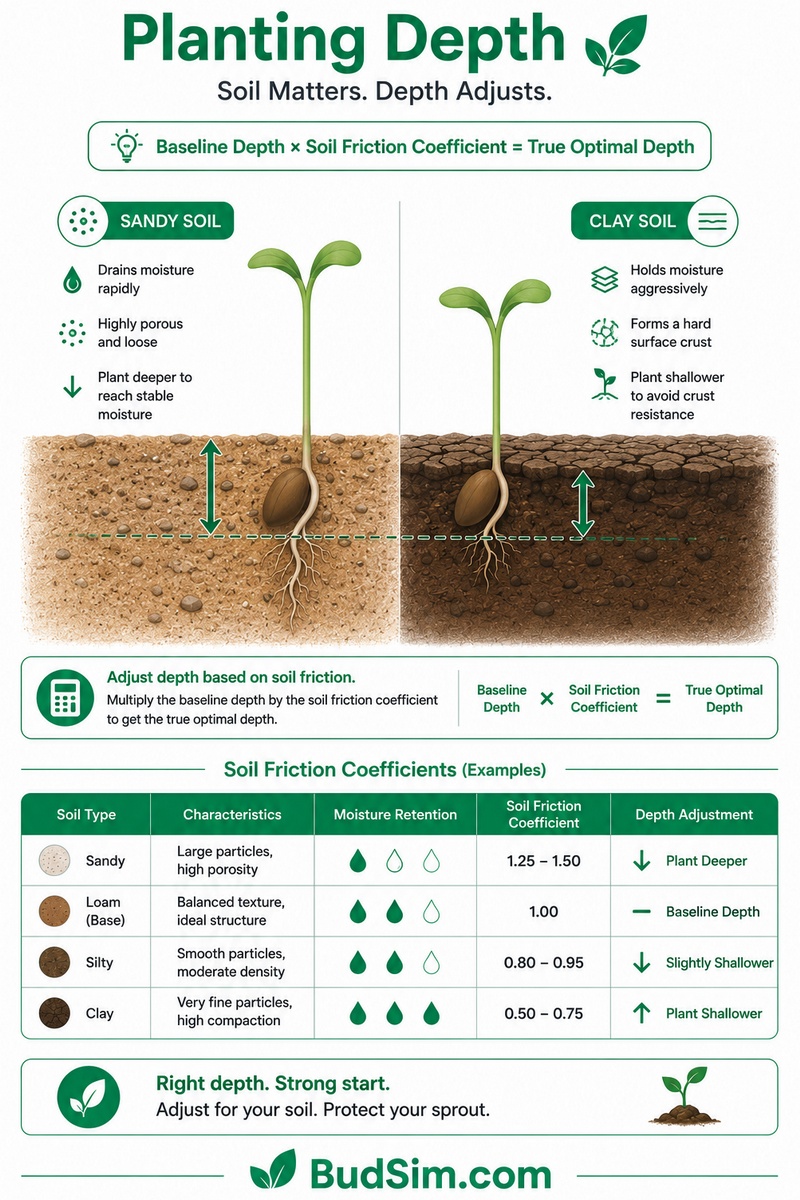
To calculate the true optimal depth, the baseline measurement must be multiplied by a soil friction coefficient. These coefficients represent the density and moisture retention capabilities of the specific soil matrix.
| Soil Classification | Texture Description | Depth Coefficient Csoil |
|---|---|---|
| Pure Sand | Loose, gritty, drains instantly | 1.35 |
| Loamy Sand | Mostly sand with minor silt | 1.25 |
| Sandy Loam | Balanced but drains quickly | 1.15 |
| Perfect Loam | Ideal structure and moisture | 1.00 |
| Silt Loam | Smooth, floury, retains water well | 0.95 |
| Clay Loam | Sticky when wet, forms clods | 0.85 |
| Silty Clay | Heavy, slow drainage | 0.80 |
| Heavy Clay | Dense, prone to severe crusting | 0.75 |
Thermodynamics and Seasonal Adjustments
Temperature plays an equally critical role in defining the final planting parameter. Seed germination is an enzymatic process driven by thermal energy.
- In early spring, soil temperatures are highly stratified. The surface layer is warmed by direct solar radiation, while layers deeper in the profile remain dangerously cold. If early season crops are planted too deep, they sit in cold, wet soil, leading to fungal rot and drastically reduced germination percentages.
- During the peak of summer, the opposite physical mechanics occur. The surface layers become excessively hot, rapidly baking the moisture out of the topsoil. Seeds planted near the surface in midsummer will desiccate before the radicle can extract moisture. Therefore, late season plantings demand a deeper placement to access cooler, hydraulically stable zones.
| Seasonal Condition | Thermal Profile | Temperature Coefficient Ctemp |
|---|---|---|
| Early Spring Cold | Surface warm, deep soil cold | 0.85 |
| Mid Spring Cool | Warming profile, high moisture | 0.95 |
| Optimal Peak Season | Stable warmth throughout profile | 1.00 |
| Late Summer Hot | Surface baking, high evaporation | 1.15 |
| Drought Conditions | Extreme surface heat, dry topsoil | 1.25 |
The Complete Real World Depth Calculation
By combining the geometric baseline with environmental modifiers, we arrive at the absolute optimal planting formula. This level of precision is what separates high yield commercial operations from casual attempts.
Master Planting Equation:
Dfinal = S * 3 * Csoil * Ctemp
Let us process a practical example using this exact formula. A grower intends to plant bush beans. According to the reference tables, the average diameter of a bush bean seed is 11 millimeters. The grower is operating in a field composed of Clay Loam soil. The current season is Early Spring Cold. We extract our values from the data tables.
Seed Diameter S = 11
Soil Coefficient Csoil = 0.85
Temperature Coefficient Ctemp = 0.85
- Step, requires calculating the baseline depth. We multiply 11 by 3 to get 33 millimeters.
- Step, applies the soil modifier. We multiply 33 by 0.85, resulting in 28.05 millimeters.
- Step, applies the temperature modifier. We multiply 28.05 by 0.85, resulting in 23.84 millimeters.
The grower should calibrate their mechanical seeding equipment to place the beans exactly 24 millimeters below the surface. This represents a massive deviation from the unadjusted baseline of 33 millimeters. Had the grower planted at 33 millimeters in cold clay, the beans would have suffered heavy losses due to delayed emergence and rot.
Spatial Density and Planting Geometry
Planting depth is only 1 axis of the spatial grid. The horizontal distribution of seeds is equally vital. In-row spacing and between-row spacing dictate the total canopy volume, root zone competition, and airflow. Poor airflow leads directly to foliar diseases. Excessive competition stunts root development. The following reference table provides standard spacing metrics for mature crop development.
| Agricultural Crop | In-Row Spacing mm/in | Between-Row Spacing mm/in |
|---|---|---|
| Amaranth | 25 / 1 | 450 / 18 |
| Anise | 150 / 6 | 450 / 18 |
| Artichoke | 900 / 35 | 1200 / 47 |
| Arugula | 75 / 3 | 250 / 10 |
| Asparagus | 450 / 18 | 1200 / 47 |
| Barley | 50 / 2 | 200 / 8 |
| Basil | 300 / 12 | 450 / 18 |
| Bean (Bush) | 100 / 4 | 600 / 24 |
| Bean (Pole) | 150 / 6 | 900 / 35 |
| Beetroot | 100 / 4 | 350 / 14 |
| Borage | 450 / 18 | 600 / 24 |
| Broccoli | 450 / 18 | 750 / 30 |
| Brussels Sprouts | 450 / 18 | 750 / 30 |
| Buckwheat | 100 / 4 | 250 / 10 |
| Cabbage | 450 / 18 | 750 / 30 |
| Caraway | 200 / 8 | 450 / 18 |
| Cardoon | 900 / 35 | 1200 / 47 |
| Carrot | 50 / 2 | 300 / 12 |
| Cauliflower | 450 / 18 | 750 / 30 |
| Celery | 200 / 8 | 450 / 18 |
| Chard (Swiss) | 200 / 8 | 450 / 18 |
| Chickpea | 150 / 6 | 450 / 18 |
| Chives | 150 / 6 | 300 / 12 |
| Cilantro | 100 / 4 | 300 / 12 |
| Collard Greens | 450 / 18 | 750 / 30 |
| Corn (Sweet) | 250 / 10 | 750 / 30 |
| Cucumber | 300 / 12 | 1200 / 47 |
| Dill | 150 / 6 | 300 / 12 |
| Eggplant | 450 / 18 | 750 / 30 |
| Endive | 300 / 12 | 450 / 18 |
| Fava Bean | 200 / 8 | 600 / 24 |
| Fennel | 300 / 12 | 600 / 24 |
| Garlic | 100 / 4 | 300 / 12 |
| Kale | 400 / 16 | 600 / 24 |
| Kohlrabi | 250 / 10 | 450 / 18 |
| Leek | 150 / 6 | 400 / 16 |
| Lentil | 50 / 2 | 300 / 12 |
| Lettuce Head | 200 / 8 | 350 / 14 |
| Melon Cantaloupe | 600 / 24 | 1500 / 59 |
| Mustard Greens | 150 / 6 | 300 / 12 |
| Oats | 50 / 2 | 200 / 8 |
| Okra | 300 / 12 | 900 / 35 |
| Onion Seed | 75 / 3 | 300 / 12 |
| Parsley | 150 / 6 | 300 / 12 |
| Parsnip | 100 / 4 | 450 / 18 |
| Pea Shelling | 50 / 2 | 450 / 18 |
| Pepper Bell | 450 / 18 | 600 / 24 |
| Pumpkin Sugar | 900 / 35 | 1800 / 71 |
| Radish Cherry | 50 / 2 | 200 / 8 |
| Radish Daikon | 150 / 6 | 400 / 16 |
| Rutabaga | 200 / 8 | 450 / 18 |
| Sorghum | 150 / 6 | 750 / 30 |
| Soybean | 100 / 4 | 600 / 24 |
| Spinach | 100 / 4 | 300 / 12 |
| Squash Butternut | 900 / 35 | 1500 / 59 |
| Squash Zucchini | 600 / 24 | 1200 / 47 |
| Sunflower | 300 / 12 | 750 / 30 |
| Tomato Beefsteak | 600 / 24 | 900 / 35 |
| Turnip | 100 / 4 | 400 / 16 |
| Watermelon | 900 / 35 | 1800 / 71 |
| Wheat | 50 / 2 | 200 / 8 |
Predictive Yield and Seed Volume Formulas
Knowing the exact spatial geometry allows growers to calculate the precise volume of seed required for any given land area. This calculation prevents over-purchasing inventory and ensures maximum density without triggering detrimental root competition. The formula requires converting all measurements to consistent units, typically square meters.
Area of a Single Plant:
Aplant = Wrow * Wspacing
Where Wrow is the distance between rows, and Wspacing is the distance between individual plants in the row. Once the area of a single plant is known, dividing the total field area by the plant area yields the theoretical maximum plant count. However, nature is imperfect. A standard safety buffer of 15 percent is added to account for failed germination, insect predation, and mechanical damage during cultivation.
Total Seed Requirement Equation:
Ntotal = Afield / Aplant * 1.15
Consider a farmer planting carrots in a field measuring exactly 1000 square meters. The in-row spacing is 50 millimeters, which translates to 0.05 meters. The row spacing is 300 millimeters, which translates to 0.3 meters. The area required for 1 carrot plant is 0.05 multiplied by 0.3, equalling 0.015 square meters.
❖ Dividing the 1000 square meter field by 0.015 gives a theoretical plant count of 66666 plants. To ensure full coverage despite losses, we apply the 1.15 multiplier. The final required seed count is 76665 seeds. This mathematical approach guarantees optimal field utilization.
Advanced Troubleshooting and Surface Germinators
While the mathematical models cover the vast majority of crops, specific genetic anomalies exist. Certain plant species possess seeds so minuscule they contain almost zero stored carbohydrates. These seeds rely entirely on immediate photosynthesis upon imbibition. These are known as light dependent germinators. If these seeds are buried even 2 millimeters deep, they will detect the absence of photons and remain dormant forever.
Species like Chamomile, Oregano, Thyme, and certain varieties of Lettuce fall into this category. For these seeds, the baseline formula of multiplying the diameter by 3 is discarded. Instead, the seeds are pressed firmly against the soil surface to establish hydraulic contact without any soil cover. Maintaining moisture for surface sown seeds requires intense micro-management, often utilizing specialized misting irrigation systems to prevent surface desiccation.
Another common mechanical failure involves soil crusting over deeply planted large seeds. When a heavy rain event is followed by intense solar baking, clay soils form a concrete-like barrier. Even a massive seed like a pumpkin, planted at its mathematically correct depth of 54 millimeters, will break its hypocotyl trying to lift a thick clay crust. Agricultural engineers combat this by utilizing mechanical crust breakers or applying thin layers of vermiculite directly over the seed trench to maintain an exit corridor for the emerging sprout.
Essential Reference Literature
Mastering agricultural mathematics and plant physiology requires continual study. The following texts provide rigorous scientific data regarding soil physics, seed biology, and commercial crop production mechanics. These resources are indispensable for anyone seeking to move beyond guesswork and implement data driven agriculture.
- The Biology of Seeds: Recent Research Advances
- Principles of Sowing and Planting Depth Dynamics
- Soil Physics and Agricultural Engineering Yield Models
- Knott’s Handbook for Vegetable Growers
- Seed Germination Theory and Practice
- Thermodynamics of Soil and Root Zone Optimization

Harrison Caldwell— Smart Yard & Precision Agro Developer
Agricultural engineer and developer specializing in interactive landscape modeling and precision calculation algorithms.


