| Pipe Volume | — |
| Total Water Demand | — |
| Pressure Drop | — |
| Flow Velocity | — |
| Pressure at End Line | — |
| Max Recommended Length | — |
| Uniformity Estimate | — |
| Required Pump Pressure | — |
| Total Emitter Count | — |
| Irrigation Zone Capacity | — |
| Total System Load | — |
Drip irrigation is one of the most efficient ways to deliver water directly to plant roots with minimal waste. It is widely used in agriculture, landscaping, greenhouse production, and even home gardens where water conservation and precision feeding matter. Understanding how pipe length, pressure, and flow rate interact is essential for building a stable and predictable irrigation system.

A drip irrigation system calculator helps translate real-world field conditions into actionable design parameters. Instead of guessing pipe sizes or emitter counts, the system is balanced using hydraulic relationships between pressure loss, flow demand, and line geometry.
Table of Contents
Why drip irrigation design matters
Every irrigation system behaves like a network of controlled resistance. Water loses energy as it moves through pipes, bends, and emitters. If the system is not balanced, some plants receive too much water while others receive too little. This leads to uneven growth, nutrient imbalance, and reduced yield.
Proper design ensures uniform distribution across the entire irrigation line. The key parameters are pipe length, internal diameter, emitter flow rate, and available inlet pressure. Even small errors in these values can significantly affect performance in long irrigation runs.
Main parameters in drip system design
Before building or analyzing a drip irrigation layout, several core variables must be understood. These parameters define how water behaves inside the system and determine whether the system will operate efficiently.
| Parameter | Description | Typical Unit |
|---|---|---|
| Pipe length | Total distance water travels in main and lateral lines | m or ft |
| Pipe diameter | Internal width of tubing affecting resistance | mm or inches |
| Flow rate | Total water volume supplied per time | L/h or gpm |
| Pressure | Force driving water through the system | bar or psi |
| Emitter count | Number of drip outlets along the line | pcs |
| Emitter discharge | Water output per emitter | L/h or gph |
These parameters are interconnected. Increasing pipe length increases resistance. Increasing diameter reduces friction losses. Increasing flow rate raises pressure demand. The balance between these factors defines system stability.
Hydraulic fundamentals used in drip systems
Although irrigation design is practical, it is based on hydraulic equations that describe flow behavior. One of the most commonly used relationships is the Hazen-Williams approximation for pressure loss in pipes. Head loss increases with flow and length while decreasing with diameter. A simplified representation is:
Hf = k × L × Q1.85 / D4.87
Where Hf represents head loss, L is pipe length, Q is flow rate, and D is pipe diameter. The constant k depends on pipe material roughness.
Pressure conversion is also essential in irrigation design:
Pout = Pin − Ploss − Pelevation
Elevation changes influence pressure because lifting water vertically requires additional energy. Every meter of elevation adds resistance that must be compensated by pump pressure or system design.
Understanding pipe length impact
- Pipe length is one of the most critical variables in drip irrigation systems. As water travels further, friction losses accumulate. This reduces pressure at the far end of the line, which can lead to reduced emitter output.
- Long irrigation lines require careful balancing. In practice, designers often limit maximum lateral length to ensure pressure variation remains within acceptable limits. If the pressure difference between the start and end exceeds a certain threshold, uniformity drops significantly.
- Shorter pipes are easier to manage but may increase installation complexity due to more branching. Longer pipes reduce infrastructure cost but require higher inlet pressure or larger diameter tubing.
Flow rate and emitter distribution
Flow rate defines how much water is delivered into the system per unit time. In drip irrigation, total flow is determined by the number of emitters multiplied by their individual discharge rate.
Qtotal = N × qe
Where N is emitter count and qe is emitter flow rate. This value must not exceed available water supply capacity. If demand exceeds supply, system pressure drops and performance becomes unstable.
❖ Emitter spacing also plays a role in uniformity. Closer spacing increases water distribution density but also raises total flow demand. Wider spacing reduces consumption but may create dry zones in soil.
Pressure behavior in real systems
Pressure is the driving force of drip irrigation. Without sufficient pressure, emitters cannot maintain consistent discharge rates. However, excessive pressure can damage tubing or cause uneven flow distribution.

A balanced system maintains pressure within a narrow operating window. Pressure regulators are often used to stabilize conditions, especially in systems with long pipe runs or varying elevation.
| Pressure range | System behavior | Typical application |
|---|---|---|
| Low pressure below 10 psi | Uneven emitter output | Short garden lines |
| Moderate 10 to 40 psi | Stable drip performance | Agricultural irrigation |
| High above 40 psi | Requires regulation | Commercial systems |
Maintaining correct pressure ensures each emitter delivers nearly identical flow, which is essential for uniform crop development.
Pipe diameter selection
Pipe diameter is often underestimated but has a major influence on system efficiency. A small increase in diameter significantly reduces friction losses because resistance decreases exponentially.
◈ Narrow pipes are cheaper but cause higher pressure drop. Wide pipes reduce energy loss but increase material cost. The optimal choice depends on system length, required flow, and pump capacity.
For long irrigation runs, increasing diameter is usually more effective than increasing pump pressure because it reduces energy demand across the entire system.
Example design calculation
Consider a simple drip irrigation line with the following conditions:
| Parameter | Value | Unit |
|---|---|---|
| Pipe length | 120 | m |
| Pipe diameter | 25 | mm |
| Emitter count | 80 | pcs |
| Emitter flow | 2 | L/h |
| Inlet pressure | 2.5 | bar |
Total demand is calculated as:
Qtotal = 80 × 2 = 160 L/h
If estimated pressure loss across the line is 0.8 bar and elevation loss is 0.2 bar, then outlet pressure becomes:
Pout = 2.5 − 0.8 − 0.2 = 1.5 bar
This value is acceptable for most drip emitters, meaning the system will operate within a stable range.
Common design mistakes
- Ignoring pressure loss in long lateral lines
- Oversizing emitter count beyond supply capacity
- Using incorrect pipe diameter for flow demand
- Neglecting elevation differences in sloped terrain
- Assuming uniform pressure without calculation
These mistakes often lead to inconsistent irrigation patterns, increased water waste, and reduced system lifespan. Proper calculation eliminates most of these issues before installation.
Practical guidelines for stable systems
Efficient drip irrigation design follows a few core principles. Systems should be kept within recommended pressure ranges. Pipe lengths should be limited according to diameter and flow capacity. Emitters should be evenly distributed to avoid hydraulic imbalance.
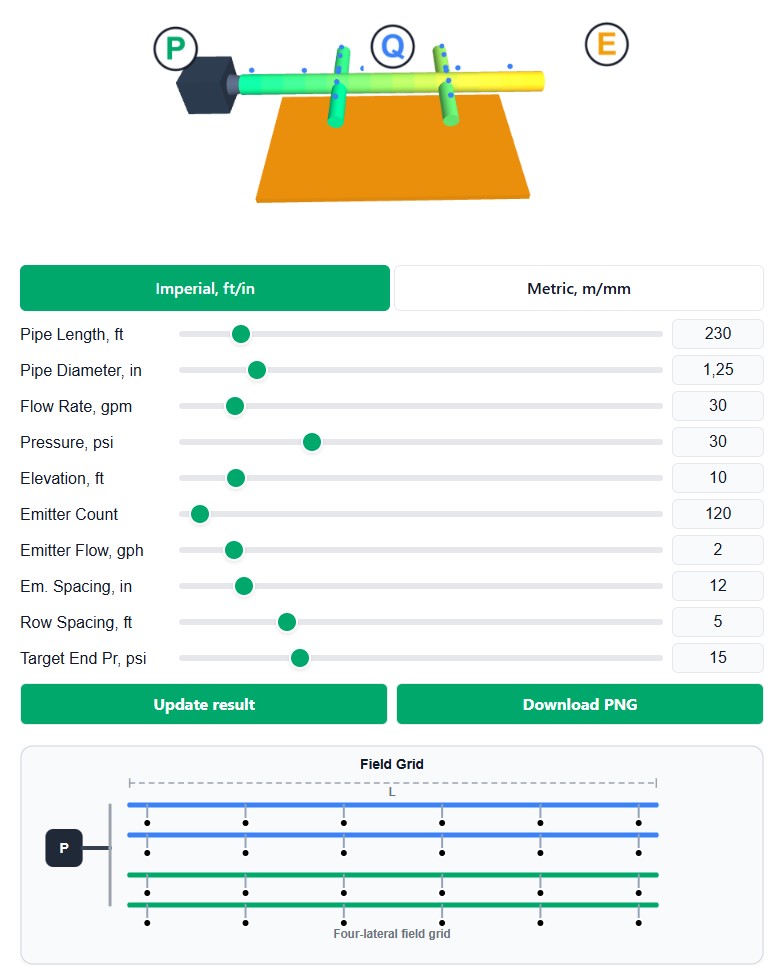
In professional installations, multiple zones are often used instead of one long line. This allows better control over pressure and flow distribution. It also improves scalability for larger agricultural fields.
Summary
A drip irrigation system calculator for pipe length and pressure flow rate is a practical tool for transforming hydraulic theory into real-world irrigation design. By understanding how pressure, flow, and geometry interact, it becomes possible to build efficient, stable, and scalable watering systems. Proper design ensures consistent plant growth, reduced water consumption, and predictable system behavior across different field conditions.
Recommended books
- Irrigation Engineering Principles and Practice
- Design and Operation of Farm Irrigation Systems
- Drip and Micro Irrigation for Trees, Vines, and Field Crops
- Hydraulics of Pipelines and Pipe Networks
- Water Distribution System Handbook

Harrison Caldwell— Smart Yard & Precision Agro Developer
Agricultural engineer and developer specializing in interactive landscape modeling and precision calculation algorithms.


